

The 2025
Travel Manager Salary & Job Satisfaction survey
BTN Europe’s third annual survey reveals a slight uptick in average salaries, but an increasing number of travel managers report feeling undervalued as professional recognition continues to lag


The 2025 Travel Manager Salary & Job Satisfaction survey
BTN Europe’s third annual survey reveals a slight uptick in average salaries, but an increasing number of travel managers report feeling undervalued as professional recognition continues to lag

Amid a backdrop of geopolitical tensions and persistent economic volatility, corporate travel managers in Europe face mounting pressure. At the same time, a rapidly evolving supplier landscape – spurred by advancements in AI and ongoing industry consolidation – is testing the agility of many. BTN Europe’s 2025 Travel Manager Salary & Job Satisfaction Survey explores how these developments are reshaping the roles and responsibilities of corporate travel professionals – and whether remuneration and recognition are keeping pace.
BTN Europe’s third annual survey highlights the average pay and bonuses for European travel managers, demonstrating once again that managing bigger travel budgets typically leads to higher earnings. While assessment metrics indicate the profession is being recognised as more strategic, this shift hasn’t been enough to boost recognition status or close the gender pay gap.
THE HEADLINE NUMBERS
The average annual salary of European travel managers has increased a mere 1.35% year-on-year but 46% say their salary is low for their responsibilities and 37% do not feel well recognised within their organisation. The gender pay gap has narrowed, albeit by a small margin, while the evidence once again shows that pay typically increases in line with both programme size and travel managers’ experience.
Read on to explore the survey findings in detail...




MARGINAL GAINS
€77,156
(+1.35%)
The average annual salary for European travel managers in 2025, excluding bonuses, is €77,156 – an increase of just 1.35% from €76,124 in 2024. In 2023, when BTN Europe first conducted the survey, the figure was €73,870.


REGIONAL RUNDOWN
BTN Europe’s third annual Travel Manager Salary & Job Satisfaction survey, like its forerunners, secured good response rates in the UK, Germany, Sweden and France, together with Italy and the Netherlands. When it comes to the average annual salary for travel managers in those nations, the UK and Germany once again emerged as the highest, at €79,182 and €77,536 respectively, up 1.5% and 2.5% year-on-year. The notably lower average annual salary for travel managers in Italy (€40,770) underscores the broader trend of comparatively lower wages in Italy compared to many Western European countries.


AVERAGE ANNUAL SALARY OF EUROPEAN TRAVEL MANAGERS BY COUNTRY
(Calculated only for the six countries with the most survey respondents)
BONUS MOVES
12.6%
The average annual bonus available to European travel managers who have such an incentive is 12.6% of their base salary, up from 11.7% in 2024. More than half of survey respondents (53%) have a bonus incorporated in their remuneration package.


MONEY MOVEMENT
More than three-quarters of survey respondents (77.6%) noted their annual salary was higher in 2025 than in 2024, an increase from the 73% of respondents who reported a pay rise in last year’s survey, and up from 65% in 2023.




MORE SPEND, MORE PAY
This third annual survey once again confirmed the assumption that travel managers responsible for larger travel programmes are rewarded with greater pay. At the lower end, for those managing less than €1 million in annual travel spend, the average annual salary is €44,971. That ultimately climbs to an average annual salary of €97,049 among those managing travel programmes exceeding €100 million in yearly spend.


AVERAGE ANNUAL SALARY OF EUROPEAN TRAVEL MANAGERS BY SIZE OF TRAVEL PROGRAMME
EXPERIENCE SHOWS
Similarly, the survey demonstrated a relationship between travel managers' industry experience and their annual pay. For respondents with three years or fewer of travel management experience, the average salary is €61,797. Among veteran travel managers with more than 30 years of experience, however, the average annual salary is €97,758.


AVERAGE ANNUAL SALARY OF EUROPEAN TRAVEL MANAGERS BY YEARS OF EXPERIENCE
GENDER INEQUALITY
For the third consecutive year, the survey revealed a significant pay gap between female and male travel managers across Europe. Women, who accounted for 63 per cent of survey respondents, earn on average €72,327 per year (up 3.46% from €69,903 in 2024). Meanwhile men, who accounted for nearly a quarter of respondents (24%), earn an average annual salary of €83,446 (up 2.53% from €81,387 last year). Those figures mean the gender pay gap has narrowed slightly and now stands at 15.4%, down from 16.4% in 2024 and 17.4% in 2023.
AVERAGE ANNUAL SALARY OF EUROPEAN TRAVEL MANAGERS BY GENDER

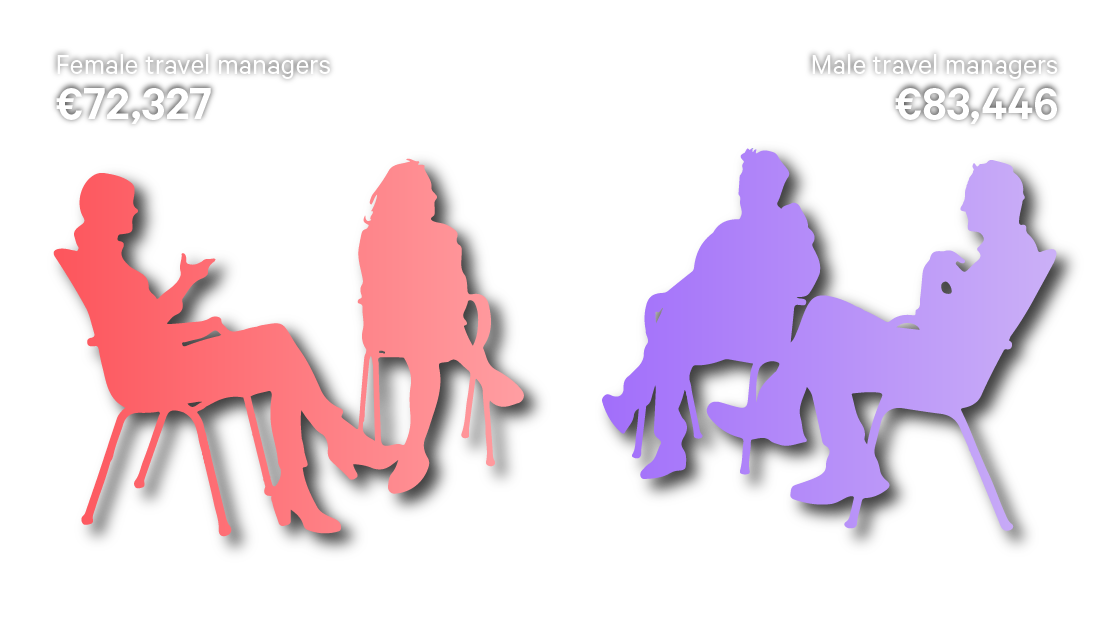
GENDER PAY GAP: 15.4%


BIG RESPONSIBILITY
Macroeconomic uncertainty, which has characterised much of the past 12 months, has had a notable impact on the roles and responsibilities of travel managers. While the selection and/or recommendation of travel suppliers was named by 89% of respondents as one of their responsibilities – topping the list for a third consecutive year – the need to manage costs (85%, +14.9% year-on-year) and negotiate rates for transient travel (71%, +10.9% year-on-year) have come into sharp focus. Consistent with the previous two surveys, only around one-third of European travel managers are involved with negotiating rates for meetings (36%) or selecting event facilities and destinations (32%).


THE RESPONSIBILITIES OF EUROPEAN TRAVEL MANAGERS
(Respondents could select multiple answers)
CHANGE IN FOCUS
In 2025, travel data and analysis emerged as the top area of increased focus for travel managers, with 62% of respondents attributing more time and effort to it. Similarly, corporate travel technology, which was the biggest area of increased focus last year, continues to attract growing attention according to 54% of buyers. Time dedicated to travel supplier sourcing experienced the most significant year-on-year increase, with 46% of buyers now placing greater emphasis on sourcing compared to 32% in 2024. Business travel sustainability, which was the primary focus in 2023, has continued to decline, with only 30% of buyers increasing their attention in this area – down from 47% in 2024. Virtual conferencing technology remains the category most frequently identified by European travel managers as receiving less attention.




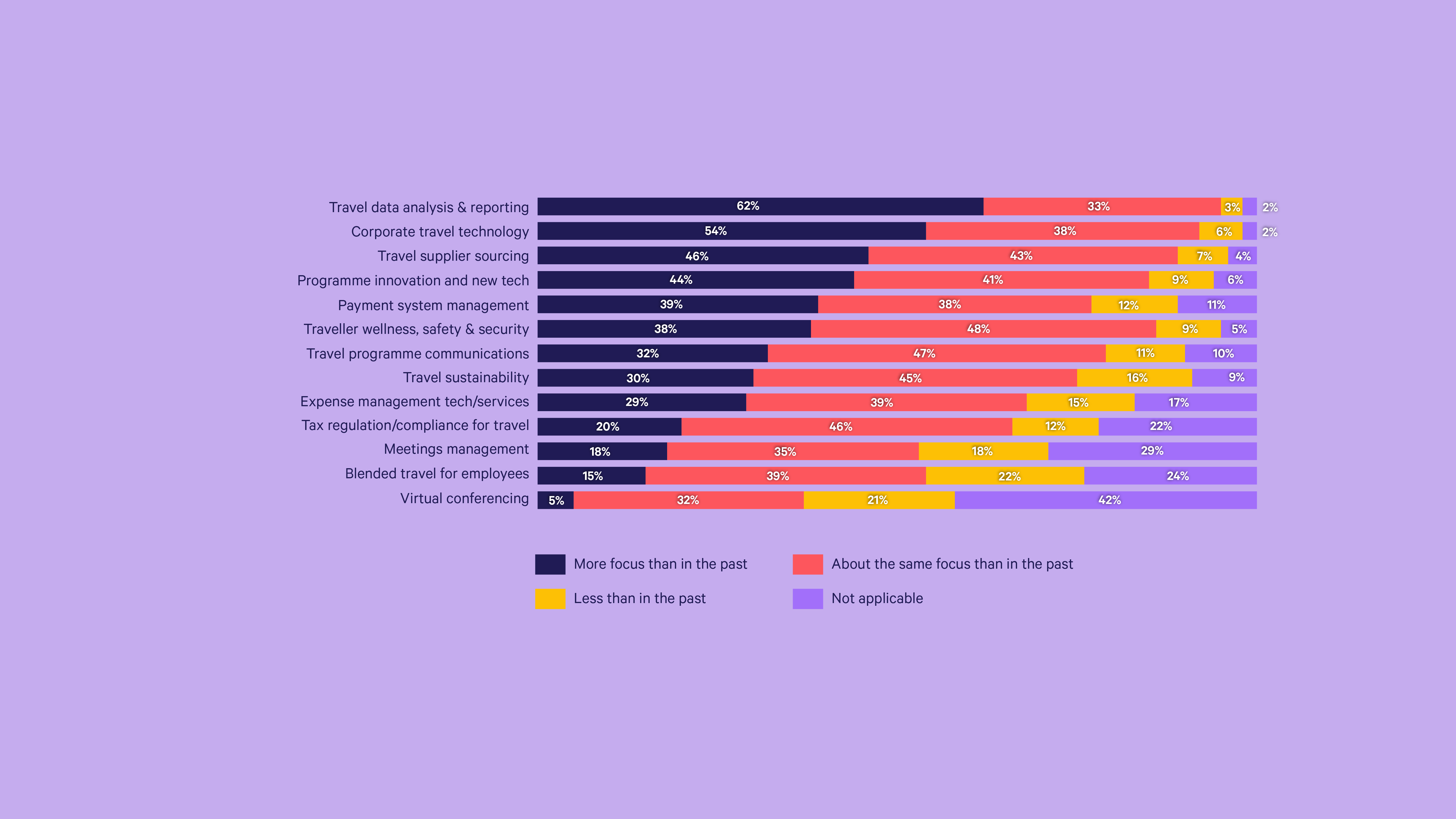
THE CHANGING FOCUS OF EUROPEAN TRAVEL MANAGERS
WHERE EUROPEAN TRAVEL MANAGERS REPORT WITHIN THEIR COMPANY
BOSSING IT
As the role of the travel manager continues to evolve, so too does the reporting structure within European corporations. While procurement remains the most common reporting line at 31% (down 2% year-on-year), the gap to human resources (20%, down 7% year-on-year) has widened. While reporting lines to the CEO, president or chair remained steady at 8% (down 1% year-on-year), the proportion of travel managers reporting to administration increased to 9% (up 3% year-on-year).
PEAK PERFORMANCE
Given this year’s focus on cost management, it’s no surprise that more than half of European travel managers (56%) are evaluated primarily on the savings or cost avoidance they deliver, making it the most common performance metric for the second consecutive year. The travel department’s strategic contribution to an organisation follows as the second most frequent criterion at 43% (up from 36% in 2024), closely followed by traveller satisfaction at 42% (up from 37% in 2024). Only 17% of travel managers (up 1% point year-on-year) are assessed based on their travel programme's progress toward ESG goals.


THE METRICS BY WHICH EUROPEAN TRAVEL MANAGERS ARE MEASURED
(Respondents could select multiple answers)


APPRECIATION ASSESSMENT
More than a third (37%) of European travel managers do not feel they get the recognition they deserve within their organisation – an increase from the 33% who said the same in 2024. Additionally, the proportion of respondents who feel only adequately recognised fell 3% year-on-year to 39%, while 24% (down 1% year-on-year) said they feel well recognised within their company.
HOW EUROPEAN TRAVEL MANAGERS FEEL ABOUT RECOGNITION WITHIN THEIR COMPANY
EUROPEAN TRAVEL MANAGERS' SALARY SATISFACTION
SALARY SHORTFALLS
Nearly half of European travel managers (46%) believe their salaries do not match their job responsibilities, though this is a slight improvement from 2024, when 50% felt dissatisfied with their pay. Meanwhile, 37% feel they are paid fairly – up 2% from last year – and 17% consider themselves well-paid, which is also up 2% year-on-year. This modest improvement coincides with a small increase in the average salary.
MIXED OUTLOOK
Although European travel managers express some dissatisfaction regarding their salaries, they continue to demonstrate strong commitment to their positions. Consistent with last year’s findings, the majority (77%) view their role as a long-term option (down 1% year-on-year), while 11% (up 4% year-on-year) consider it more temporary. The remaining 12% are uncertain (down 3% year-on-year) about their long-term intentions.
EUROPEAN TRAVEL MANAGERS' FOCUS ON THEIR JOB
WHERE EUROPEAN TRAVEL MANAGERS SEE THEMSELVES IN TWO YEARS
LOOKING AHEAD
When asked about their prospects in the next two years, one-third (33%) of travel managers are expecting a promotion (up 7% from last year), while 36% anticipate staying in their current role with the same employer (up 2% year-on-year). Only 11% foresee switching employers (down 5% year-on-year), while 4% plan to retire.


TRIALS & TRIBULATIONS
As in previous years, the 2025 Travel Manager Salary & Job Satisfaction survey included two open-ended questions, inviting respondents to share their biggest challenges of the year and the most significant industry developments they think will impact them in 2026. The responses revealed several recurring themes.
Qualitative survey responses reveal that macroeconomic changes have impacted Europe’s corporate environment, with numerous buyers citing the likes of “new management”, “culture change”, and “company politics” as significant challenges in 2025. Consequently, effective internal stakeholder management – and the delicate juggling act required to align diverse stakeholder expectations – remains a persistent challenge for many buyers.
One travel manager highlighted “leadership dynamics that need to be navigated and addressed at each change in structure”, while another said their biggest challenge is “trying to make management understand that managing business travel is not like organising a holiday”. Similarly, another travel professional pointed to “line managers who have no concept of the travel management responsibilities that factor into my role,” which they stated is “a hinderance”.
Multiple buyers cited increased industry consolidation – particularly among TMCs – as contributing to market uncertainty, which may lead to a rise in RFP activity in 2026. Meanwhile, rapid advances in technology have left some travel buyers struggling to adapt to the pace of change. This is particularly felt when it comes to content distribution and applications of AI within managed travel.
One buyer commented: “Everything is so short-lived; constant change everywhere”. Another travel manager highlighted the continual challenge of keeping up with technological advancements, especially while “trying to work my way through the organisation's processes to get the tech introduced for our travellers”.
Buyers expressed both optimism and caution towards AI. Cutting through the noise is a key concern, with one buyer stating they are “applying pressure on external suppliers to identify those which are adapting with speed and those that are not”. Another said they are weighing up “expectations versus the deliverables and capabilities” and questioning “how travel suppliers will use AI to really support the travel programme and [to] be more relevant”.
Another travel buyer added: “One of the biggest changes I foresee in the coming year is the integration of AI-driven tools and predictive analytics into global travel management. These technologies will transform how we manage traveller safety, optimise costs and personalise the travel experience. For example, AI can predict disruptions, suggest alternative routes, and automate compliance checks, which means my role will shift from operational tasks to more strategic oversight [to ensure] these tools align with company policy and deliver measurable ROI.”
Travel managers anticipate ongoing economic and geopolitical instability in 2026, with security and risk management remaining central concerns. Survey respondents noted an "unsettled world" and increased "protectionism from various governments" as factors that are likely to add pressure on companies to further cut costs next year.
While numerous buyers reported doing more with less in 2025, one respondent said the focus of their company’s travel programme has “moved entirely to making transactional savings, taking away most of the strategic element of my role.” Another said they are looking to “define and implement a stricter travel policy with mandatory bookings through our travel agent – for everyone” to better manage costs.
Sustainability was a top concern for buyers in 2024, but it became less of a priority in 2025, with cost management taking centre stage. In 2026, regulatory changes in Europe will influence whether companies shift their attention back to sustainability or focus elsewhere. Meanwhile, advancements in technology, artificial intelligence, and ongoing industry consolidation are expected to be the main topics on the corporate agenda.
SURVEY METHODOLOGY
Business Travel News Europe’s 2025 Travel Manager Salary & Job Satisfaction report is based on the responses of 263 individuals who completed a survey fielded by BTN Europe, to European travel managers, between 28 October and 28 November 2025. Not all participants completed the survey in full and responses were vetted to ensure validity. Respondents, who completed the survey anonymously, were able to enter salary details in the currency of their choice, thus conversions were necessary and made on 28 November. More than three-quarters of respondents were based in one of seven countries: the UK, Italy, Sweden, Germany, the Netherlands, Finland and France. Respondents' travel progammes varied in size, with the most respondents managing spend in the €3 million to €9.9 million and €10 million to €24.9 million brackets. Travel management experience peaked in the 10 to 20 years bracket, dropping off at similar rates among those with less experience and those with more.
See below for more information on survey respondents
Location of survey respondents
Respondents' gender
Respondents' annual travel spend
Respondents' travel management experience
With thanks to…
BTN Europe would like to thank the following organisations for their promotion of and support for the 2025 Travel Manager Salary & Job Satisfaction survey: French Association of Travel Management (AFTM), Italian Association of Travel and Mobility Managers (AITMM), Association of Swiss Travel Management (ASTM), Danish Business Travel Association (DBTA), Finnish Business Travel Association (FBTA), the UK's Institute of Travel Management (ITM), Netherlands Association for Travel Management (NATM), Norwegian Business Travel Association (NBTA), Swedish Business Travel Association (SBTA), Travel for Business, and German business travel association Verband Deutsches Reisemanagement (VDR).

See also...
• The 2024 Travel Manager Salary & Job Satisfaction survey
• The 2023 Travel Manager Salary & Job Satisfaction survey